About…
My CV
Positions
| 2026 – present | Research Professor, IMMS Institute, Ewha Womans University, Republic of Korea |
| 2025 – present | Visiting Professor, ShanghaiTech University, People’s Republic of China |
| 2024 – 2026 | Senior Scientist, ETH Zürich, Switzerland |
| 2024 – 2026 | Scientific Guest, Max Planck Institute for Solid State Research, Germany |
| 2022 – 2024 | Postdoctoral Researcher, Max Planck Institute for Solid State Research, Germany |
| 2019 – 2021 | FWO Postdoctoral Fellow, EMAT, University of Antwerp, Belgium |
| 2018 – 2019 | Postdoctoral Researcher, Delft University of Technology, The Netherlands |
Education
All at the University of Parma, Department of Chemistry.
- PhD in Chemistry, 2018
- MSc in Materials Chemistry, 2014
- BSc in Chemical Sciences, 2011
Awards and honours
- Nardelli Medal early-career prize — Italian Crystallographic Association
- Best Oral Presentation — 9th International Conference on MOFs and Open Framework Compounds, Singapore
- Best MSc Thesis prize — Italian Crystallographic Association
- Poster Prize — 24th Meeting of the International Union of Crystallography, Hyderabad, India
- Poster Prize — 5th Granada International School of Crystallisation, Spain
Grants
As lead proposer:
- Swiss National Science Foundation — Project grant (10.006.600), CHF 304,400
- Research Foundation – Flanders (FWO) — Postdoctoral grant (12ZV120N), €250,000
- Max Planck Society — MPG Cooperation Fellowship, €72,000
- Science and Technology Commission of Shanghai — Collaborative research grant, ¥400,000
- University of Parma — Research scholarship and international mobility grant, €9,500
As co-author:
- European Research Council — International Cooperation (101022633), €2,240,000
- Max Planck Society — Diversity Excellence, €25,000
- Swiss National Science Foundation — Scientific Exchange (IZSEZ0_202950), CHF 10,500
Teaching
International schools
- Invited lecturer · 4th International School on Porous Materials, Como, Italy (2025)
- Invited lecturer · 10th European School of Crystallography, Ohrid, North Macedonia (2025)
Workshops and seminars
- Understanding present and future single-crystal diffraction analysis — University of Uppsala (2025)
- Introduction to the 3D-ΔPDF — ETH Zürich (2024)
- Quality assessment of crystallographic analysis — Max Planck Institute for Solid State Research (2023)
- Diffuse scattering and the crystallography of disorder — University of Antwerp (2019)
- XRD data interpretation: what is my powder trying to tell me? — TU Delft (2018)
- Information mining and diffuse scattering from single crystals — University of Parma (2017)
- Gel-based crystal growth methods for difficult crystallisation cases — University of Parma (2017)
- MOFs as applied coordination chemistry in modern materials science — University of Parma (2017)
Earlier teaching assistance at TU Delft and the University of Parma, in general and inorganic chemistry and in structure–property relationships.
Public educational material
- Hydrogen Bond: definition, examples, special cases — a structural chemistry tutorial for the Cambridge Crystallographic Data Centre, freely available.
- Crystallographic visual teaching series (I–VIII) — freely available on Behance and in the CCDC’s DECOR collection.
- Fourier Tiler — software for associative learning of crystallography.
Contributions to the scientific community
Scientific associations
- Korean Crystallographic Association · 2026–present
- IUPAC, Division VIII · 2025–present
- Swiss Society for Crystallography · 2024–2026
- EU4MOFs network (COST CA22147) · 2023–present
- International Zeolite Association · 2023–present
- European Crystallographic Association · 2017–present — founding member and officer of SIG14
- Italian Crystallographic Association · 2014–present
Committees
- Distinguished panellist · 2nd Mediterranean Conference on Porous Materials, Marrakesh
- Symposium session chair · Nobel Symposium NS193, Karlskoga, Sweden
- Symposium chair and organiser · 34th and 35th European Crystallography Meetings, and the IUCr 2026 Congress
- Grant reviewer · Deutsche Forschungsgemeinschaft (DFG)
Science communication
- Content creator and curator · ReciprocArt galleries, on Behance and Instagram
- Organiser and presenter · European Researchers’ Night, Parma (2015–2017)
- Organiser and presenter · Mantova Science Festival (2016–2017)
- Organiser and presenter · museum exhibition for the International Year of Crystallography, Parma (2014)
My science
It was an evening like any other — so to speak — at the Elettra synchrotron in Trieste, where I saw it for the first time in my single-crystal diffraction patterns. A phenomenon that made no sense to me: not Bragg diffraction, not amorphous background, not smeared peak profiles from sample damage, nor anything else I could understand. Broad, soft intensities with unique shapes. An enigma that eluded my knowledge, and that of my peers and teachers. I later learned it already had a name: single-crystal diffuse scattering.
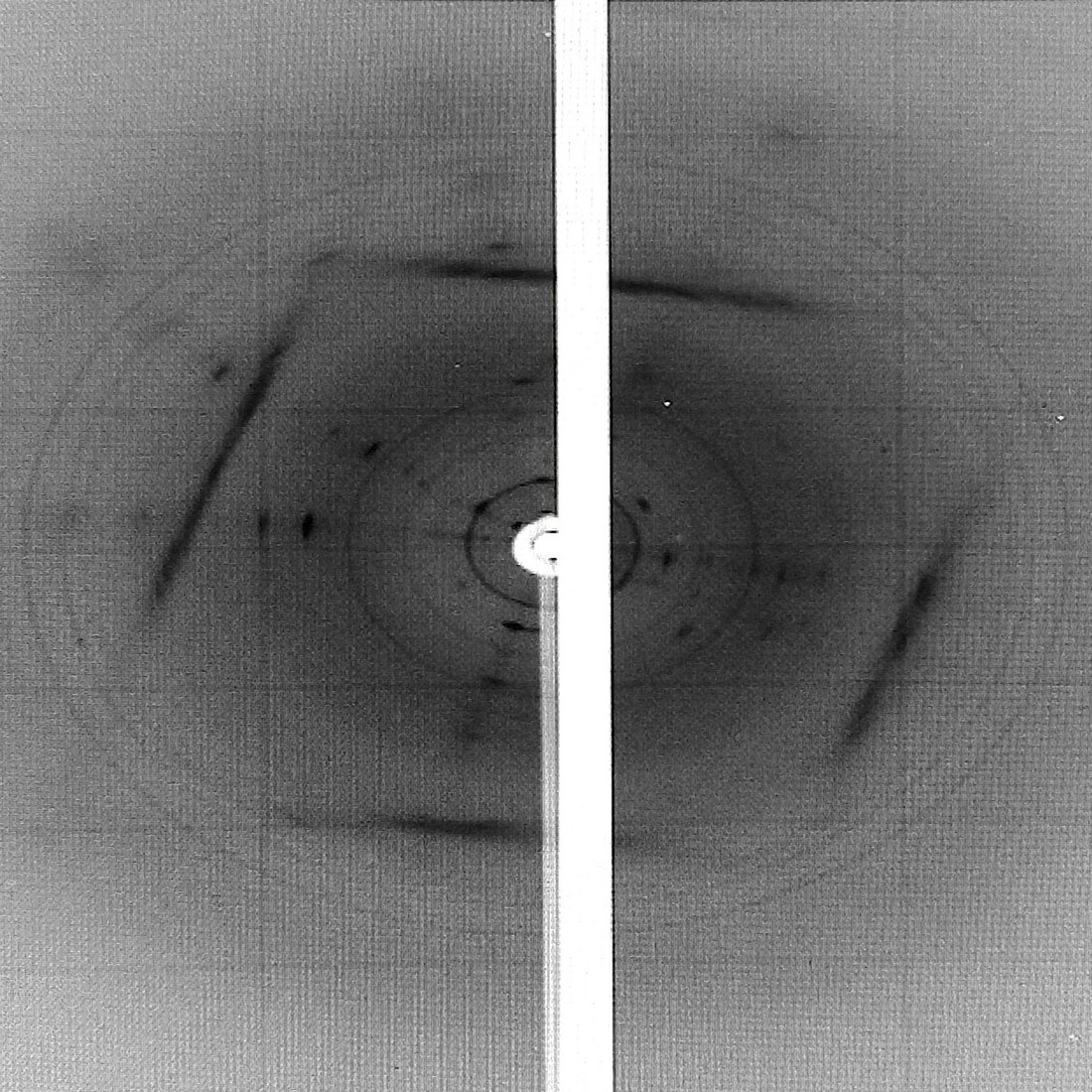
Diffuse scattering from a metal–organic framework sample, collected at the Elettra synchrotron (beamline XRD1) in 2016. This image is a smartphone snapshot I took during a colleague’s data collection, and it marked the moment of my personal discovery of the single-crystal total scattering phenomenon.
That was 2016, and I understood immediately that I had found a challenge that would make me learn something completely new: the structure of crystals beyond the average picture contained in a CIF file, which I already felt too narrow and idealised for a goal as important as crystallography — the description of the atomic structure of crystals.
It took from that moment until the final year of my PhD to realise how important the analysis of diffuse scattering could be for structural chemistry and materials science, and to become convinced that single-crystal diffraction analysis had to become a routine total scattering technique, sooner rather than later.
That this thought arrived while I was working on metal–organic frameworks (MOFs) is anything but a coincidence. The more I looked at diffraction data from MOF single crystals, the more I realised that diffuse scattering was ubiquitous and particularly abundant, and the keeper of invaluable information on the natural harmony of order and disorder within every real crystal.
That awareness became what I still hold as my scientific mission: to help turn single-crystal diffraction analysis into a routine, widely known and fully automated total scattering technique, and so to make the chemistry of disorder an accessible and reproducible discipline.
My education
The home of my academic education was the University of Parma, where I stayed until I completed my PhD in Chemistry in 2018. During those years, the passion for crystals I had had since childhood became the raison d’être of my academic career. The “Mario Nardelli” structural chemistry laboratory was my classroom, with a Bruker SMART CCD diffractometer as my playground and many fine crystallographers as my teachers, whom I will always remember with deep gratitude.
Outside Parma, I took part in memorable schools such as the International School of Crystallography in Erice (2015), the 3rd European Crystallography School in Bol (2016), and the International School on Crystallization in Granada (2016). During my PhD, I also researched abroad hosted by the laboratories of Martin U. Schmidt (Goethe University Frankfurt), Hans-Beat Bürgi and Ruggero Frison (University of Zurich), and Duane Choquesillo-Lazarte and Juan Manuel García-Ruiz (Laboratorio de Estudios Cristalográficos, Granada). Here, I met very special scientists, some of whom would later become friends and collaborators.
My culture
My growth has been coloured by a kaleidoscope of influences by various arts and disciplines. As a strong believer in the role of polymathy in making us better at understanding the world and interacting with it, I owe much of who I am, as a person and a scientist, to the precious works of many artists, scientists and educators. These are the ones I credit the most.
YouTube educators
These precious people fed my enthusiasm and curiosity with essential nutrients and new perspectives on the world around me:
- Derek Muller — Veritasium
- Michael Stevens — Vsauce
- Hannah Fry — The Rest Is Science (with Michael Stevens)
- Grant Sanderson — 3Blue1Brown
- Brady Haran — Numberphile, Sixty Symbols, Periodic Videos
- Destin Wilson Sandlin — SmarterEveryDay
- Dianna Cowern — Physics Girl
- Steve Mould
- Kyle Hill
- Hank Green — Journey to the Microcosmos, SciShow, Vlogbrothers
- Clint Laidlaw — Clint’s Reptiles
- Danielle Dufault — Animalogic
- Alex O’Connor
- Neil deGrasse Tyson — StarTalk
…and many others I keep discovering.
Traditional Kung Fu and Taoism
After spending my teenage years practising various sports (rugby, basketball, volleyball, table tennis and swimming), I discovered Kung Fu [功夫; Chang Dsu Yao lineage] at 17. Little did I know then that it would give me most of my philosophical and methodological backbone: its study came with that of a variety of martial arts including Tai Chi [太極拳], Shaolin [少林拳], Pa Kua [八卦掌], Mei Hua [梅花拳] and others, but also of Chi Kung [氣功] meditation and Taoist philosophy. The latter trained me in exercising the search for the inherent opposite in every emergent phenomenon or evident concept — something that, in my view, lies at the heart of innovation and discovery throughout history, alongside sheer luck. Taoism also taught me about the erosive power of desire on rationality, and the wisdom of empathy in navigating societies.
At 28, after 11 years of practice sometimes reaching 10 hours per week, an injury forced me to stop training for several months. As my MSc studies in Chemistry intensified, I eventually decided to make natural philosophy (Science) my future, and quit my increasingly time-demanding school of Kung Fu, where until then I had contemplated continuing as a teacher for the foreseeable future. Among its greatest gifts, besides the physical and athletic benefits, I left with a special mindset in the search for knowledge, and the discovery of a few important classics of Chinese philosophy. One of them, the Tao Te Ching [道德經] by Lao Tzu [老子], keeps revealing new meanings and has a special place in my PhD thesis as the introductory quote of one of its chapters.
Japanese animation
While Kung Fu and Taoism showed me how to approach understanding, Japanese animation had a perhaps subtle yet decisive influence on how I started navigating the questions of a psychological, existential and social nature that wove through my upbringing. As the general reader might have guessed, I am not talking about anime aimed at pre-adolescents, such as Dragon Ball, One Piece or Naruto, although one should not assume that such works are devoid of important lessons on empathy, inclusivity, self-acceptance and many other values. To better understand what kind of works I am thankful to have discovered and to have been influenced by, one can look into the following titles:
- Neon Genesis Evangelion [新世紀エヴァンゲリオン] (Hideaki Anno; manga by Yoshiyuki Sadamoto)
- Ghost in the Shell [攻殻機動隊] (Mamoru Oshii; manga by Masamune Shirow)
- Serial Experiments Lain (Ryūtarō Nakamura; written by Chiaki J. Konaka)
- Ergo Proxy (Shūkō Murase; written by Dai Satō)
- Cowboy Bebop [カウボーイビバップ] (Shinichirō Watanabe; written by Keiko Nobumoto)
- Wolf’s Rain (Tensai Okamura; written by Keiko Nobumoto)
- Mushishi [蟲師] (Hiroshi Nagahama; manga by Yuki Urushibara)
- Akira (Katsuhiro Otomo, from his own manga)
- Welcome to the N.H.K. [NHKにようこそ!] (Yūsuke Yamamoto; novel by Tatsuhiko Takimoto)
- Planetes [プラネテス] (Gorō Taniguchi; manga by Makoto Yukimura)
- Last Exile (Koichi Chigira)
- Fullmetal Alchemist [鋼の錬金術師] (Seiji Mizushima; manga by Hiromu Arakawa)
- Haibane Renmei [灰羽連盟] (Tomokazu Tokoro; manga by Yoshitoshi ABe)
- Seirei no Moribito [精霊の守り人] (Kenji Kamiyama; novel by Nahoko Uehashi)
- Magnetic Rose [彼女の想いで], from Memories (Kōji Morimoto; written by Satoshi Kon, from Katsuhiro Otomo’s manga)
- Jin-Roh [人狼] (Hiroyuki Okiura; written by Mamoru Oshii, from his own manga)
- Satoshi Kon’s films — Perfect Blue, Paprika, Tokyo Godfathers
- Hayao Miyazaki’s films — most notably Princess Mononoke, Spirited Away, Howl’s Moving Castle
These works are only part of a much richer set of titles that accompanied me along the way.
Useful thoughts
These are quotes and thoughts I came across and consider worth remembering.
Humility is not thinking less of yourself, it’s thinking of yourself less.
C. S. Lewis
Science is the belief in the ignorance of experts.
Richard P. Feynman
An expert is someone who has made all possible errors once.
George M. Sheldrick
Let everything happen to you: beauty and terror. Just keep going. No feeling is final.
Rainer Maria Rilke
All models are wrong, but some are useful.
George E. P. Box
There is a crack in everything — that’s how the light gets in.
Leonard Cohen
When you change the way you look at things, the things you look at change.
Max Planck
Most scientific problems are far better understood by studying their history than their logic.
Ernst W. Mayr
Forge meaning, build identity.
Andrew Solomon
I am, somehow, less interested in the weight and convolutions of Einstein’s brain than in the near certainty that people of equal talent have lived and died in cotton fields and sweatshops.
Stephen Jay Gould
We may have no meaning in the cosmic context of the universe, but we make our own meaning daily with each other, and this is the thought that leads to action.
Derek A. Muller — Veritasium, Our Greatest Delusion
Any increase in knowledge anywhere helps pave the way for an increase in knowledge everywhere.
Isaac Asimov